

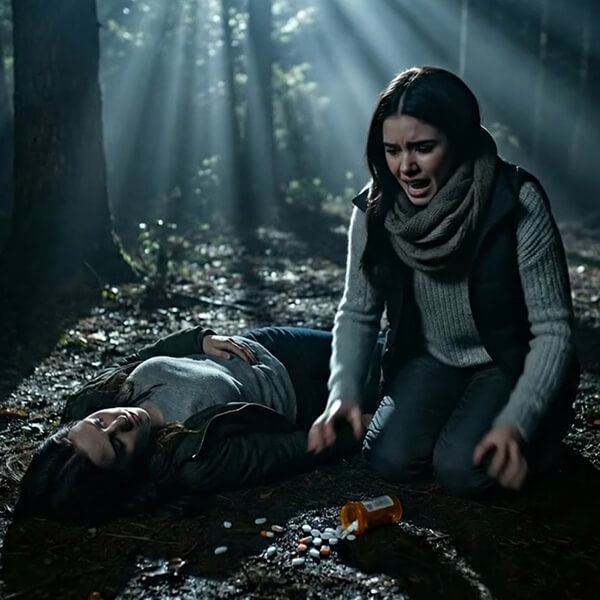

Unique Counseling Approaches: The effects of psychological trauma—whether from passive (social media) or active (sexual assault) sources—have a profoundly devastating effect on the developing minds of our youngest netizens, often resulting in a variety of anxiety-related disorders including post-traumatic-stress disorder (PTSD), which has recently been reclassified under the heading of “Trauma- and Stressor-Related Disorders.” In so doing, the American Psychiatric Association moved PTSD out of the “Anxiety Disorders” category to underscore that PTSD is a disorder “directly connected” to an external event and not just a fear-based illness. This is precisely the point made about “the betrayal” in The Gentling of Hanna Johansen: it’s not due to some inherent “phobia” but is in fact spawned by a specific event or a series of events over a period of time that can later create a variety of “phobias” that actually mask the underlying source(s) of the stress disorder, such as Hanna’s andro- beikon- and claustro-phobias.
One of the newest therapeutic strategies for engaging teens and tweens suffering from current or past traumatic stress is displayed in this novel as “gentling,” a term borrowed from the equestrian manual for “taming” a wild horse rather than “breaking it.” The distinction between the two (taming vs breaking) goes to the heart of this heartfelt and heartwarming collaboration between Andy Collins (Hanna’s step-grandfather) and Alexa Muybridge (Hanna’s psychiatrist) who “double-team Hanna” in their care of and concern for Hanna’s survival and ultimate wellbeing. Their approach is experimental in that it’s a trust-based risk-sensitive model that includes deciphering “Hanna-code” (her “linguistic camouflage”) and interpreting the meaning behind Hanna’s remarkably insightful collection of original songs, the lyrics of which are imbedded as soundtracks in this novel.





Unique Counseling Approaches: The effects of psychological trauma—whether from passive (social media) or active (sexual assault) sources—have a profoundly devastating effect on the developing minds of our youngest netizens, often resulting in a variety of anxiety-related disorders including post-traumatic-stress disorder (PTSD), which has recently been reclassified under the heading of “Trauma- and Stressor-Related Disorders.” In so doing, the American Psychiatric Association moved PTSD out of the “Anxiety Disorders” category to underscore that PTSD is a disorder “directly connected” to an external event and not just a fear-based illness. This is precisely the point made about “the betrayal” in The Gentling of Hanna Johansen: it’s not due to some inherent “phobia” but is in fact spawned by a specific event or a series of events over a period of time that can later create a variety of “phobias” that actually mask the underlying source(s) of the stress disorder, such as Hanna’s andro- beikon- and claustro-phobias.
One of the newest therapeutic strategies for engaging teens and tweens suffering from current or past traumatic stress is displayed in this novel as “gentling,” a term borrowed from the equestrian manual for “taming” a wild horse rather than “breaking it.” The distinction between the two (taming vs breaking) goes to the heart of this heartfelt and heartwarming collaboration between Andy Collins (Hanna’s step-grandfather) and Alexa Muybridge (Hanna’s psychiatrist) who “double-team Hanna” in their care of and concern for Hanna’s survival and ultimate wellbeing. Their approach is experimental in that it’s a trust-based risk-sensitive model that includes deciphering “Hanna-code” (her “linguistic camouflage”) and interpreting the meaning behind Hanna’s remarkably insightful collection of original songs, the lyrics of which are imbedded as soundtracks in this novel.

Charles Coleman, PhD began his long and distinguished career in mental healthcare early-on with his experiences working with Vietnam Vets committed to—and confined in—one of the Army’s only dedicated military psychiatric hospitals in the early ‘70s, as so graphically memorialized in his critically-acclaimed American cult-classic novel, Sergeant Back Again, (HarperCollins, 1980)—“The Vietnam War Novel that Made PTSD Real!.”
 From then on, he’s worked, taught, lived with, lectured and written about PTSD culminating in helping his friend and colleague,Andy Collins, PhD, to write about Andy’s own successes and failures in dealing with PTSD in this engaging, highly experimental, and wonderfully collaborative work you’re now about to read. The Gentling of Hanna Johansen: A Betrayal of Trust marks a watershed moment in portraying the devastating effects of social media, predatory influencers, and psychological trauma (PTSD+) on adolescents, particularly in the United States, which Charles and Andy define in the course of this novel as “the evolution of the uniquely American adolescent psychotype.”

Hanna Johansen (fifteen-and-a-half when the story opens) is quick to point out in her “Afterwords” that her “participation” in co-authoring this novel was the last thing she ever wanted. You’ll see why once she appears about a quarter of the way through “The Gentling,” when the story suddenly becomes so personal, intimate and shocking that even she can’t write about all of it. But Hanna is clever in the ways in which she reveals her multiple personalities, whether in the lyrics of her songs, her immersion in deviant and risky behaviors, her warmth and love and humor, or her devotion to her friends, all of which are supported with thoughtful understanding by her psychiatrist, Alexa Muybridge.
Hanna’s a gifted, tell-almost-all writer you’ll come to cherish: “I know now that surviving a good night’s sleep is what The Gentling of Me is all about. About always leaving the bedroom door in your mind opened like Andy does. And now me.”

Alexa Muybridge, MD, stands by Hanna through thick and thin via their (verbatim) tele-psychiatry sessions which eventually “uncover” the One Hanna barely intact still buried under the many shattered pieces and parts of her “Old Self” before the betrayal. As early into her professional career as Alexa is, she’s developed a unique method of DBT-PTSD and WET therapies customized for teens and tweens suffering from anxiety and disruptive mood dysregulation disorders, PTSD, dissociative identity and major depressive disorders: which is to say that Hanna is extremely dis-ordered and suicidal.
Applying what Andy and Alexa come to call a “gentling approach” to dialectical behavioral and creative exposure therapies (via Hanna’s songs and journal), they cautiously lead her—and the reader—to the grave’s edge of the frightful exhumation of her betrayed Self and the inevitable, long-anticipated endgame: “asphyxiation by submersion,” the same method used by her alter ego to end her life.
 If only the strong are destined to survive, as some say, then our own innate Sense of Self, conditioned by resilience-reflexes, and the power of our convictions will keep us well enough and mentally prepared to withstand this assault and, hopefully, the next. That is a premise underlying this collaborative saga, a premise that is tested over and over again in the thoughts behind the actions of the main characters, which Andy defines for Hanna as “motive”—the “whys” behind the “what’s” of what we do or don’t do, regardless of whether our actions are premeditated or seemingly mindless… a process that Hanna comes to call “connecting the dots.” By reverse-engineering her thoughts-into-actions “dots,” Hanna comes to a remarkable self-discovery when she admits:
“Thinking about something and acting on it are two very different things. But that’s how I survive now…. It’s the only way I’ve found to keep my daredevil emotions in check, those emotions I’m better off writing into my songs rather than acting them out in real life. Some of my lyrics belong in my songs and not in my behavior. It’s a slippery slope for me: Do I live what I write or write what I live? Either way, it’s a dare of one kind of another. It’s tricky.” It’s a sentiment similar to what Hanna describes in her “Afterwords” about creative people, like Vincent van Gogh and Amy Winehouse… about the “voices that other people don’t have” and overstaying visits to “dark places” in the pursuit of creativity.


I just finished The Gentling of Hanna Johansen by Hanna Johansen & Charles Coleman, and I honestly don't think this is the kind of book you simply read and move on from. It is deeply emotional, thought-provoking, and incredibly human. From the very beginning, I could feel that this story was about much more than one girl's journey. It explores trauma, grief, healing, trust, and the complicated ways people shape each other's lives. What I loved most was how carefully the characters were written. Every person felt like they carried their own emotional weight, making the story feel authentic and meaningful. Hanna's journey touched my heart, and the guidance from Papa Andy and Dr. Alexa added so much depth to the story. Their compassion and understanding reminded me that healing is never simple, but it is always possible with the right people by your side. The pacing is thoughtful rather than fast, allowing every emotion and conversation to truly sink in. It is the kind of book that encourages reflection.


More Than a Horse: Understanding the Power of “The Gentling” Metaphor

The Quiet Corner: Why the New Hampshire Cabin is Hanna’s Most Important Therapist